
James Clear’s masterpiece gave us the framework: 1% better every day, identity-based habits, and the four laws of behavior change. But the habit universe is missive, and these six books explore different galaxies within it.
Each book below offers something Atomic Habits touches on but dives deeper into whether it’s the neuroscience, the emotional psychology, or the practical application for specific life areas like wealth or relationships.
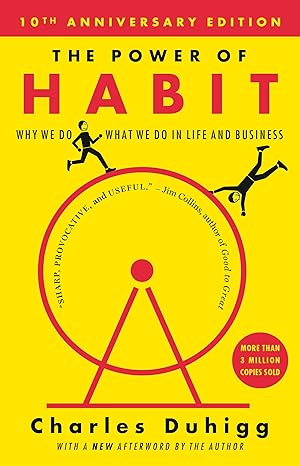
1. The Power of Habit: Why We Do What We Do in Life and Business
By Charles Duhigg
At a Glance
- Published: 2012
- Pages: 400
- Best for: Understanding the science behind habit formation
Who Should Read This
- Readers who loved the science sections of Atomic Habits
- Business leaders wanting to change organizational culture
- Anyone struggling with “why” they can’t break certain habits
Book Summary
Duhigg introduces the neurological loop at the core of every habit: Cue → Routine → Reward. Using fascinating case studies from how Procter & Gamble turned Febreze into a billion-dollar product to how football coach Tony Dun gy transformed the worst team in the NFL he demonstrates that this loop is unchangeable. You can’t extinguish a bad habit, but you can change the routine while keeping the cue and reward the same.
Some habits matter more than others. Duhigg identifies “keystone habits” means small changes that start a chain reaction, reshaping other habits. Exercise is a classic keystone habit: people who start exercising start eating better, smoking less, and being more productive at work. Find your keystone habit, and everything else becomes easier.
Key Takeaways
| # | Takeaway | Why It Matters |
|---|---|---|
| 1 | The Golden Rule of Habit Change: You can’t extinguish a bad habit, you can only change it | Keep the same cue and reward, insert a new routine |
| 2 | Belief is essential for sustaining long-term change | Habits stick when you believe change is possible (often through community) |
| 3 | Small wins fuel transformative changes | Keystone habits create structures that help other habits flourish |
Best Quotes
“Change might not be fast and it isn’t always easy. But with time and effort, almost any habit can be reshaped.”
Where to Buy
Kindle Format: Get on Amazon →
Audiobook Format: Get Audiobook →
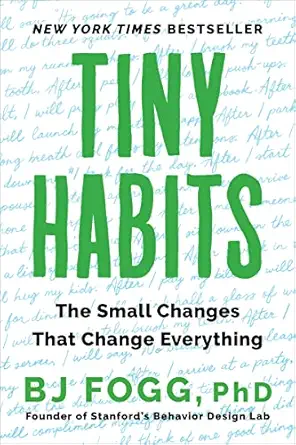
2. Tiny Habits: The Small Changes That Change Everything
By BJ Fogg, PhD
At a Glance
- Published: 2019
- Pages: 320
- Best for: People who struggle to start ANY habit
Who Should Read This
- People who’ve tried and failed at habits multiple times
- Those who feel “lazy” or “undisciplined”
- Anyone who loved the 1% improvement concept
Book Summary
BJ Fogg, a Stanford researcher who actually taught James Clear, presents his revolutionary model: B = MAP (Behavior happens when Motivation, Ability, and Prompt converge). Most people fail at habits because they focus on motivation (which fluctuates) instead of ability (making habits easy) and prompts (reliable triggers).
Fogg introduces the concept of “tiny habits” behaviors that take less than 30 seconds and require minimal effort. Want to floss more? Start with flossing ONE tooth. Want to exercise? Start with two pushups after you pee. These tiny behaviors feel almost laughably small, but they bypass your brain’s resistance and build momentum.
Key Takeaways
| # | Takeaway | How to Apply |
|---|---|---|
| 1 | Make it tiny | “After I do one habit, I will increase other habit” |
| 2 | Celebrate immediately | Say “I’m great!” or fist-pump after each tiny habit |
| 3 | Don’t rely on motivation | Design for low motivation days |
| 4 | Use existing routines | Anchor new habits to established routines |
Best Quotes
“Tiny is mighty. The small steps you take today will compound into massive changes tomorrow.”
Where to Buy
Kindle Format: Get on Amazon →
Audiobook Format: Get Audiobook →
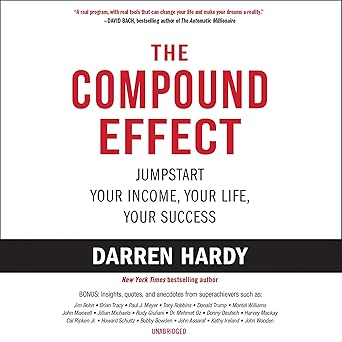
3. The Compound Effect
By Darren Hardy
At a Glance
- Published: 2010
- Pages: 192
- Best for: Entrepreneurs and wealth builders
Who Should Read This
- Business owners and entrepreneurs
- People focused on financial independence
- Readers who need motivation more than theory
Book Summary
Hardy opens with a powerful story: a ship traveling from Los Angeles to Hawaii that’s off-course by just one degree will miss the islands entirely. Tiny corrections, applied consistently, determine whether you reach your destination or drift into oblivion. The Compound Effect is about making those tiny course corrections daily.
Hardy’s non-negotiable principle: what gets measured gets improved. He advocates for detailed tracking of habits—not just big ones like exercise, but small ones like how many times you complain or how many minutes you spend on social media. Tracking creates awareness, and awareness is the first step to change.
Key Takeaways
| # | Takeaway | Application |
|---|---|---|
| 1 | Track everything for 30 days | Use a journal to track 3-5 key habits |
| 2 | Replace “I’ll try” with “I will” | Language shapes commitment |
| 3 | Create winning routines | Morning/evening routines set the tone |
| 4 | Find accountability | Share goals with someone who’ll check in |
Best Quotes
“The Compound Effect is the principle of reaping huge rewards from small, seemingly insignificant actions.”
Where to Buy
Kindle Format: Get on Amazon →
Audiobook Format: Get Audiobook→
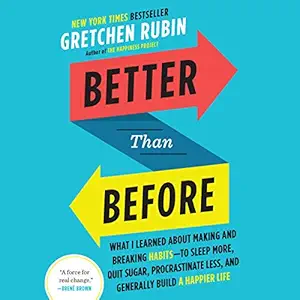
4. Better Than Before: Mastering the Habits of Our Everyday Lives
By Gretchen Rubin
At a Glance
- Published: 2015
- Pages: 320
- Best for: Understanding YOUR specific habit personality
Who Should Read This
- People who’ve tried “one-size-fits-all” habit systems and failed
- Those interested in self-knowledge and personality
- Readers who loved the identity aspect of Atomic Habits
Book Summary
Rubin’s breakthrough framework: people fall into four categories based on how they respond to expectations:
- Upholders meet inner and outer expectations readily
- Questioners meet only expectations they justify
- Obligers meet outer expectations but struggle with inner ones
- Rebels resist all expectations
Your Tendency determines which habit strategies will work for you. Obligers need external accountability. Questioners need reasons. Rebels need choice and identity.
When you start matters. Rubin explores how beginnings (New Year’s, birthdays, Mondays) create momentum, and how to use transitions throughout your day as habit anchors.
Key Takeaways
| # | Takeaway | For Your Tendency |
|---|---|---|
| 1 | Know your Tendency | |
| 2 | Use scheduling | Questioners need reasons; Obligers need deadlines |
| 3 | Create loopholes | Rebels need freedom within structure |
| 4 | Find your foundation | Sleep and diet affect all habits |
Best Quotes
“What we do every day matters more than what we do once in a while.”
Where to Buy
Kindle Format: Get on Amazon →
Audiobook Format: Get Audiobook→
5. The One Thing: The Surprisingly Simple Truth Behind Extraordinary Results
By Gary Keller & Jay Papasan
At a Glance
- Published: 2013
- Pages: 240
- Best for: Focus, productivity, goal achievement
Who Should Read This
- Overwhelmed professionals with too many priorities
- Entrepreneurs trying to scale
- Anyone who feels busy but not productive
Book Summary
Keller demolishes common productivity myths:
- Everything matters equally (it doesn’t some things matter much more)
- Multitasking works (it’s actually task-switching and kills focus)
- Discipline is everything (discipline is limited; habit is forever)
- Willpower is always available (willpower is depletable use it wisely)
The core question: “What’s the ONE Thing I can do such that by doing it, everything else will be easier or unnecessary?” This question cuts through complexity and reveals the highest-leverage activity in any area of life.
Key Takeaways
| # | Takeaway | Daily Practice |
|---|---|---|
| 1 | Ask the ONE Thing question daily | Before starting work, identify your ONE priority |
| 2 | Time block 4 hours for your ONE Thing | Protect this time ruthlessly |
| 3 | Accept being unreasonable | You can’t say yes to everything |
| 4 | Live by the domino effect | Focus on knocking over the first domino |
Best Quotes
“What’s the ONE Thing you can do such that by doing it everything else will be easier or unnecessary?”
Where to Buy
Kindle Format: Get on Amazon →
Audiobook Format: Get Audiobook→
Which Book Should You Read Next?
| If You Want… | Read This |
|---|---|
| Deep science of habits | The Power of Habit |
| Simplest, most actionable system | Tiny Habits |
| Wealth and success focus | The Compound Effect |
| Personalized approach | Better Than Before |
| Laser focus and productivity | The One Thing |